Bachelor-/Masterthesis: Empirical Studies of Ecosystem-Based Digital Production
Digitalization is a key driver of innovation across industries and offers substantial value creation potential. Under the concept of Industry 4.0, production systems have increasingly integrated digital technologies such as digital twins and advanced engineering methods, enabling higher product variety and customization. Despite these advances, many digitalization initiatives in manufacturing have faced significant obstacles, including high implementation effort, limited scalability, low acceptance, and increasing system complexity—particularly in small and medium-sized enterprises.
While information technology (IT) and production technology are converging at the technological level, fundamental structural differences remain. Manufacturing systems are typically characterized by complex, specialized, and closed solutions that are incrementally digitized. In contrast, IT is shaped by open, modular ecosystems built on shared standards, layered architectures, and interconnected services, enabling flexibility and rapid innovation.
These structural differences directly affect value creation. Traditional industrial production relies on linear value chains, whereas IT ecosystems operate as dynamic value networks with distributed and bidirectional interactions. The transformation toward ecosystem-based models has reshaped multiple industries and significantly influenced competitive dynamics.
Topics and Approaches
This research investigates the theory that an ecosystem-based approach to the digitalization and virtualization of production is a prerequisite for dynamic value creation networks and, consequently, for long-term competitiveness.
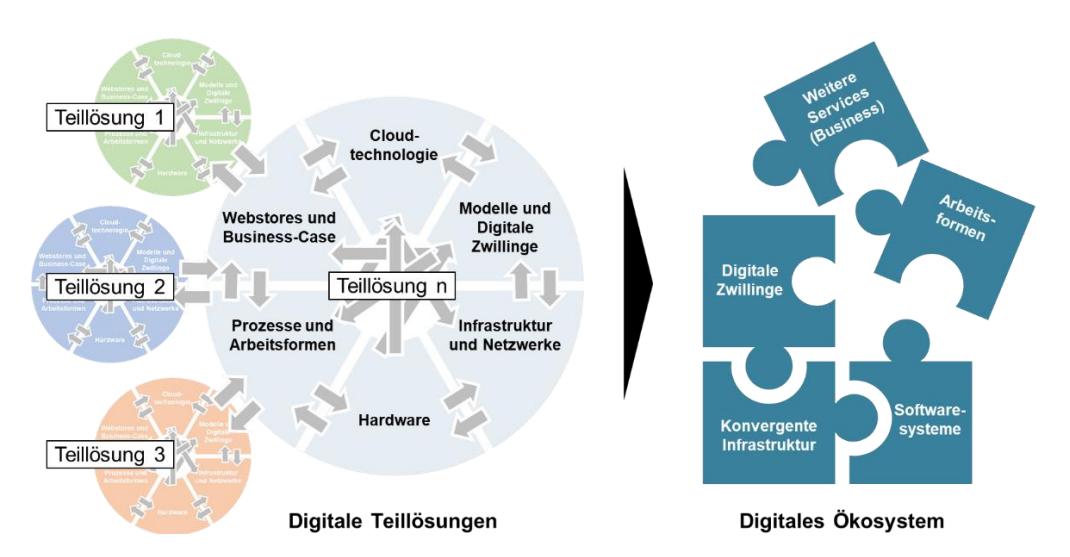
This theory is examined through a set of closely coordinated bachelor’s and master’s theses, each contributing an independent empirical study. While all theses address the same overarching research question, each employs a distinct empirical methodology. The theses are designed to collaborate closely, sharing a common conceptual framework and aligning their analytical dimensions, while generating complementary empirical evidence. For each of the following methodologies, one dedicated bachelor’s or master’s thesis is conducted.
Thesis 1: Focus group workshops investigate collective perspectives and interaction-driven insights. This includes the formulation of dimension-specific guiding questions and the co-design of workshop materials, the identification of key focus group participants from a software engineering perspective, support during workshop execution, and a dimension-specific analysis of the results.
Thesis 2: Expert discussions with intermediaries, associations, and professional bodies capture meso-level viewpoints and institutional perspectives. This involves the development of dimension-specific discussion questions, the identification of relevant intermediaries, associations, and organizations, support during the execution of the discussions, and a structured, dimension-specific evaluation of the findings.
Thesis 3: A large-scale survey to capture an overall sentiment provides quantitative breadth across stakeholder groups. The methodology comprises the formulation of dimension-specific questionnaire items, the provision of dimension-specific contacts for targeted mailing campaigns, and the subsequent dimension-specific analysis of the collected data.
Thesis 4: Expert interviews focus on in-depth individual perspectives and nuanced experiential knowledge. This includes the development of a dimension-specific interview guide that incorporates insights from previously collected results, the selection and recruitment of suitable experts, the conduct of the interviews, and the systematic analysis of the qualitative data.
Across all methodologies, several shared methodological principles apply. Each study is guided by a common set of analytical dimensions derived from the ecosystem perspective. Data collection instruments are tailored to these dimensions while remaining method-appropriate. The studies iteratively build on one another, allowing earlier findings to inform subsequent data collection and analysis. They focus on the software engineering aspects of an ecosystem-based approach to production systems.
Our Offer
- Possibility to tailor the thesis to your individual interests and strengths.
- Close supervision within an interdisciplinary research project at the intersection of software engineering and production systems.
- Integration into a collaborative research environment with multiple coordinated theses and shared empirical studies.
- Access to industry partners, associations, and real-world use cases in the context of digital production ecosystems.
- Opportunity to contribute to a strategically relevant research topic with strong academic and practical relevance.
Your Profile
- Pursuing a Bachelor’s or Master’s degree in Computer Science, Software Systems Engineering, or a related field.
- Solid interest in software architecture, modular systems, and interoperability.
- Motivation to engage with interdisciplinary topics bridging IT and production technology.
- Ability to work independently and systematically on research-oriented tasks.
- Strong analytical skills and interest in empirical research methods (qualitative and/or quantitative)
Contact
For more information, please send a short description of your background and an overview of your grades to Marc Schmidt schmidt@se-rwth.de.